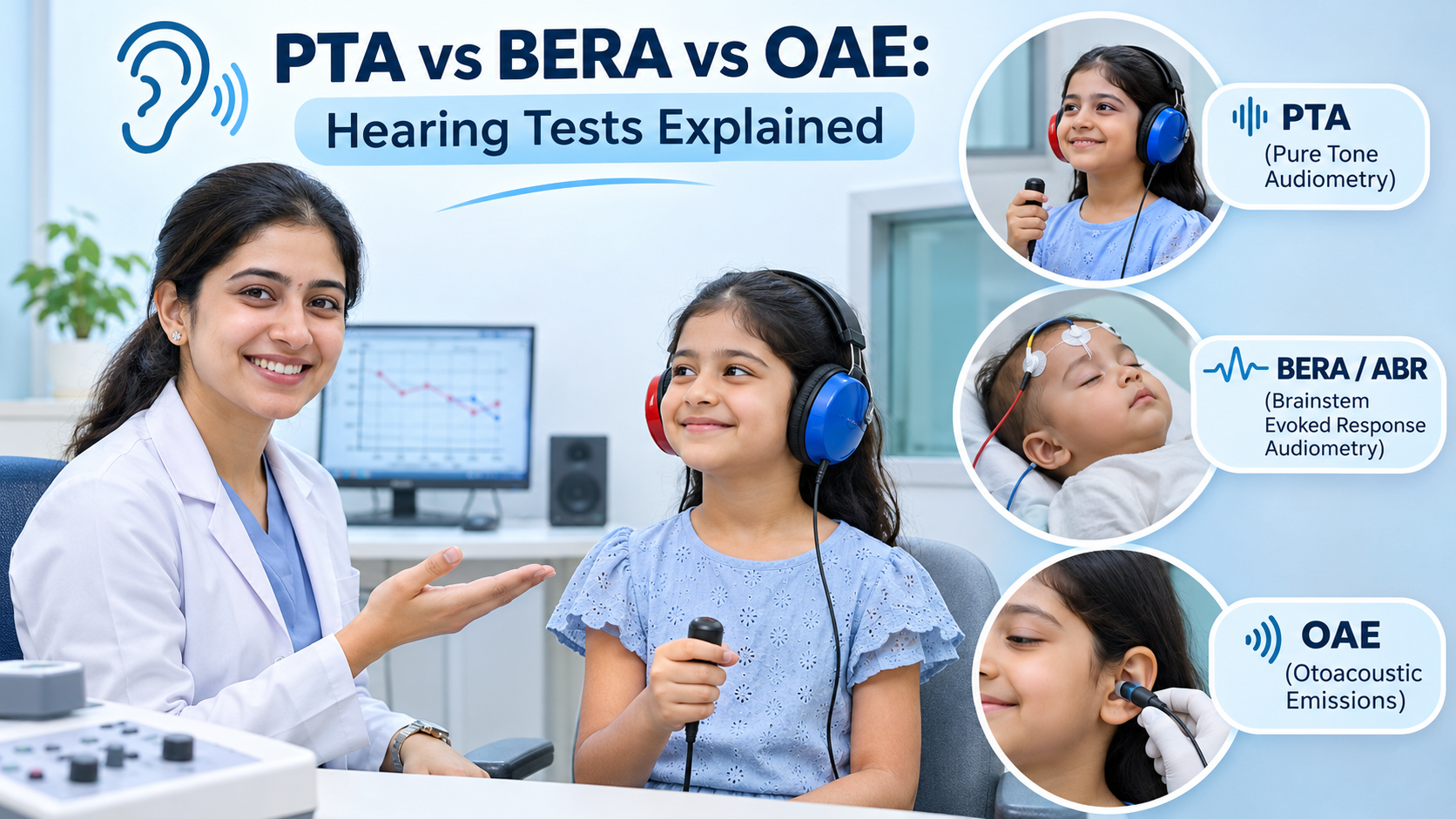
A PTA test may be recommended when someone:
Struggles to understand conversations.
Frequently asks others to repeat themselves.
Has difficulty hearing in noisy surroundings.
Notices persistent changes in hearing.
Requires an audiological assessment before hearing aid selection.
PTA provides important information about hearing sensitivity. However, additional examinations may be needed to understand the cause and nature of a hearing problem.
What Is a BERA Hearing Test?
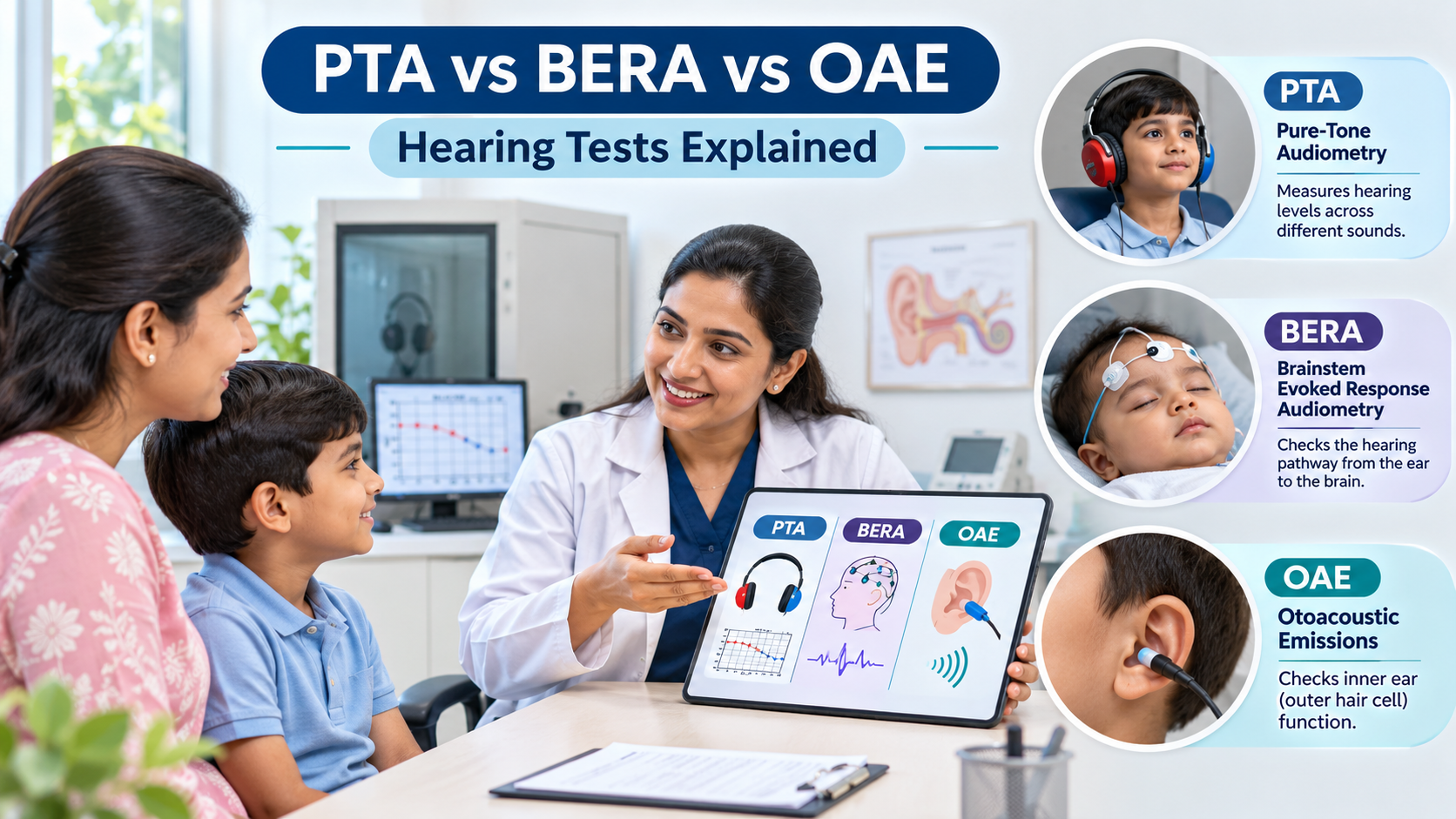
Brainstem Evoked Response Audiometry (BERA), commonly known as Auditory Brainstem Response (ABR) testing, assesses electrical responses generated along the auditory nerve and brainstem pathways following sound stimulation.
Unlike standard behavioural hearing testing, BERA does not require the patient to press a button or verbally respond whenever a sound is heard.
How Does BERA Testing Work?
During the procedure, small recording electrodes are placed on the skin, usually on the head or nearby areas.
Earphones deliver sounds while the equipment records electrical responses associated with auditory activity.
The patient is generally encouraged to remain relaxed and still. Infants may be tested while sleeping. Preparation and any sleep-related arrangements depend on the patient’s age and the clinical procedure.
The audiologist interprets the recorded waveforms to obtain information about auditory pathway responses. Certain ABR methods can also help estimate hearing thresholds.
Who May Need a BERA Hearing Test?
BERA may be recommended for:
Infants who require diagnostic hearing assessment.
Young children unable to complete reliable behavioural testing.
People who cannot consistently respond to conventional hearing tests.
Selected investigations involving auditory nerve or brainstem function.
Cases where earlier hearing-test results require further clarification.
Importantly, BERA does not replace every other hearing test. Its results are interpreted alongside the patient’s clinical history and other findings.
What Is an OAE Hearing Test?
Otoacoustic Emissions (OAE) testing measures sound responses produced by the cochlea, particularly its outer hair cells.
The cochlea is the hearing-related structure in the inner ear. It helps transform sound vibrations into signals that can be processed by the auditory system.
To understand its role, read our guide on how the human ear works.
How Does OAE Testing Work?
A small probe is placed gently into the ear canal.
The probe presents sounds and records the responses generated by the inner ear. The patient does not need to press a button or identify the sounds.
OAE testing is generally quick and non-invasive. However, movement, surrounding noise, earwax or middle-ear conditions can affect the results.
Why Is OAE Used in Newborn Hearing Screening?
OAE testing is commonly used to screen babies because it does not require them to actively respond to sounds.
Newborn hearing-screening programmes may use OAE, automated ABR (AABR), or both.
A screening result indicates whether further assessment may be needed. It should not be confused with a complete diagnostic hearing evaluation.
Can OAE Detect Every Hearing Problem?
No. OAE measures responses associated with cochlear function, but it does not evaluate every part of the auditory system.
Present OAEs do not rule out every hearing disorder, including certain auditory neural conditions.
Similarly, absent OAEs do not always mean permanent cochlear hearing loss. Ear canal blockage or middle-ear problems can also affect the result.
Therefore, an audiologist may recommend additional testing when necessary.